
By Jonathan Schack
Sales Director, Arobotech
A New Level of Precision
In manufacturing, words like precision, tolerance, and micron are used so often that we sometimes stop thinking about what they truly mean.
In the grinding industry, microns have become part of everyday conversation. Surface finish. Runout. Roundness. Concentricity. Profile accuracy.
What’s easy to forget is that this level of precision was not always the expectation.
Over time, specifications tightened. Engine life increased. Machine performance improved. And as those demands evolved, the tolerances required to support them evolved as well.
Today, in many grinding applications, micron-level control is no longer exceptional. It is expected.
Which raises an important question:
What does one micron actually represent?
Putting a Micron Into Perspective
A micron is one millionth of a meter. That’s accurate, but it doesn’t mean much until you put it into context.
A human hair is roughly seventy microns wide. A sheet of paper is about one hundred microns thick. A red blood cell measures around eight microns.
Those comparisons help, but they still don’t fully capture the scale.
Because when we talk about holding one micron, we’re not just talking about something small. We’re talking about controlling something that is a fraction of what the human eye can see and doing it consistently.
That’s where the difference lies.
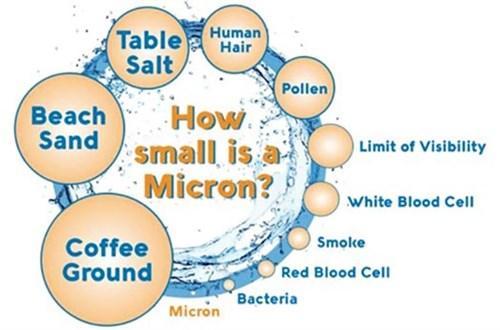
It’s not the size itself that makes a micron challenging. It’s the expectation that it can be achieved, repeated, and maintained in a real manufacturing environment.
From Millimeters to Microns
What makes this scale even more interesting, at least from my perspective, is how dramatically it can shift depending on the application.
Early in my career, I worked in a transmission manufacturing environment where precision was critical. Drawings called out tolerances in the range of hundredths of a millimeter, and there was a clear expectation that those limits had to be held consistently. It was my first opportunity to understand how even small dimensional variations can influence the performance of a complex mechanical system. At the time, it felt like the limit of what precision could be.
Later in my career, I moved into the seating industry, where I was responsible for complete seat systems across materials ranging from metal and plastics to foam. The change was immediate, and honestly, a bit shocking at first. Foam components were often held to tolerances in the range of ±10 millimeters. Coming from a world where much smaller variation mattered, it didn’t seem to make sense.
But over time, I came to understand why it made sense in that application.
The difference wasn’t about discipline or capability. It was about design, materials, and processes. Foam behaves differently than metal. The function of the part is different. The manufacturing methods are different. The tolerances are driven by what the application requires.
That experience changed how I think about precision.
Because precision isn’t about making everything as tight as possible. It’s about making it as precise as necessary.
Now, fast forward to today.
We’re talking about holding surface profiles on large crankshafts to within one micron.
Precision at Scale Changes Everything
These are not small, delicate parts. These are heavy, complex components, often several feet long, rotating at speed, subject to forces that naturally introduce deflection, heat, and instability.
And yet the expectation remains the same. Hold the geometry. Maintain the profile. Deliver consistency at a level that is nearly invisible.
That doesn’t happen by chance.
At the micron level, everything matters. The weight of the part matters. Thermal growth during grinding matters. Machine dynamics matter. And perhaps most critically, the ability to control and adjust the process matters.
You Can’t Control What You Can’t Adjust
This is where the conversation shifts from measurement to control.
It is one thing to measure a micron. It is something entirely different to consistently achieve it. And the difference between those two often comes down to the design of the system itself.
In grinding applications, especially on larger workpieces, small adjustments can have a significant impact on the final result. But those adjustments only matter if they can be made with precision and repeatability.
If the system used to support and position the part cannot respond at the same level as the tolerance being held, then control becomes guesswork.
Engineering for Micron-Level Control
That challenge is what drives engineering forward.
At Arobotech, it led to the development of Superior Fine Adjustment, or SFA.
On the surface, the concept is simple. A ninety degree rotation of an adjustment screw produces one micron of centerline movement. But behind that simplicity is a significant amount of engineering effort.
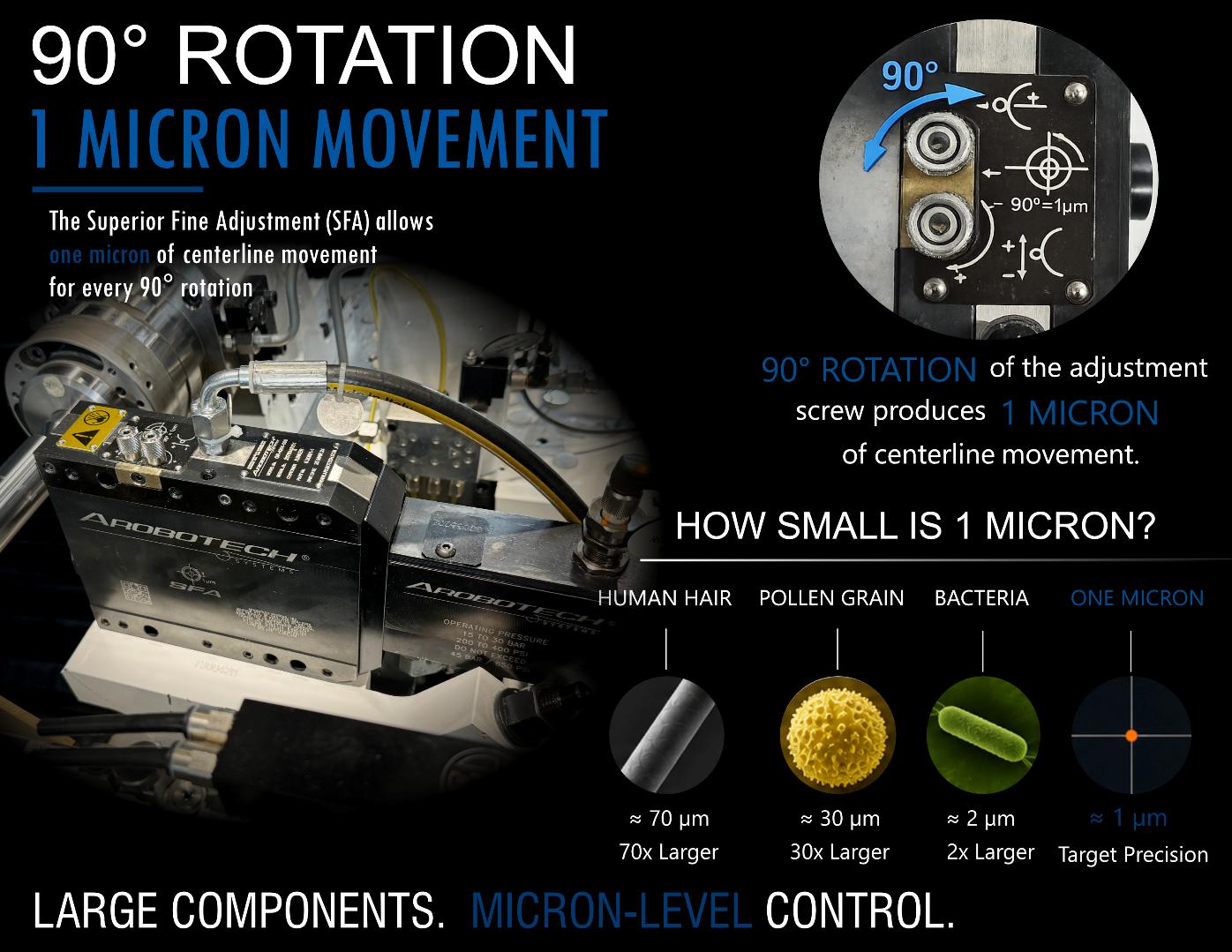
Creating a system that can translate a small mechanical input into a controlled, repeatable movement at the micron level requires more than just fine threads. It demands rigidity throughout the structure. It requires the elimination of backlash. It depends on consistent mechanical behavior over time, not just in a controlled environment, but in real-world grinding conditions.
Because at this level, there is no room for inconsistency. Any variation shows up immediately in the part.
Why It Matters
What makes this capability so important is not the number itself. It is what that level of control enables.
When adjustments can be made and repeated at the micron level, setups become more predictable. Variation between parts is reduced. Surface finishes improve. Scrap decreases. Confidence in the process increases.
In other words, precision becomes something you can rely on, not just something you hope to achieve.
Final Thoughts
A micron is easy to say. It fits neatly into a specification or a conversation.
But understanding what it represents, and more importantly what it takes to control it, is where the real value lies.
Because in today’s grinding environment, especially when working with large, complex components, that level of precision is not just impressive.
It is expected.
Start the Conversation
Want to learn more about Arobotech’s SFA Technology?
Our team is ready to answer any questions you might have.
